Your Personal Tipping Point: When Staying the Same Becomes Unbearable
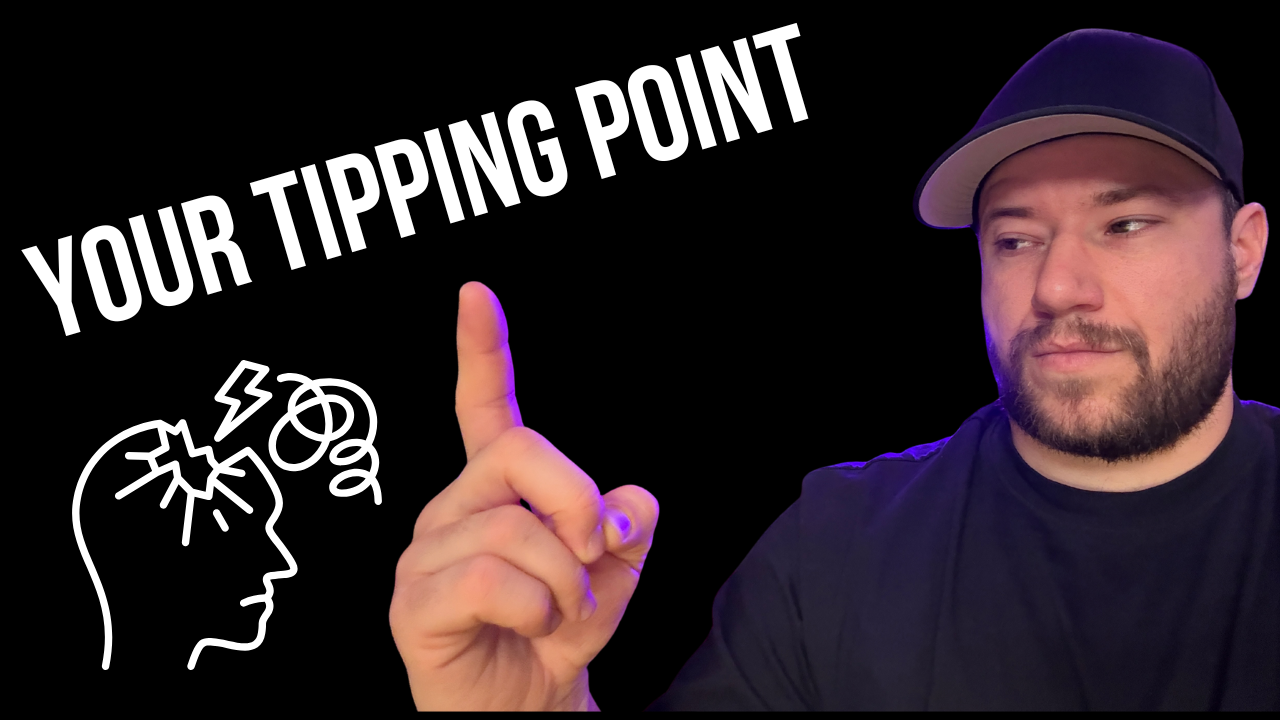
A thoughtful man wearing a black cap and shirt points upward next to bold white text that reads “Your Tipping Point.” Beside him is a white line drawing of a human head with lightning bolts and scribbles, symbolizing mental clarity, emotional breakthrough, and life transformation.
What Is Your Personal Tipping Point?
You don’t change because you feel ready.
You don’t change because you feel motivated.
You change because staying the same becomes unbearable.
Your personal tipping point is the moment life stops negotiating with you. The moment where truth finally outweighs fear. The moment when something inside you says, “I cannot continue like this.” It is rarely graceful. It is rarely planned. And it often feels like everything is unraveling all at once.
But that unraveling? That’s the beginning of the avalanche.
The Avalanche Moment
Most people can point to one event that split their life into before and after.
It might look like:
A divorce
A breakup
A mental health crisis
Burnout
The death of someone close
Losing a job
A deep identity shift
The pandemic forcing you to sit alone with your thoughts
Sometimes it is quieter. You run out of distractions. You run out of noise. You run out of Netflix, and suddenly you’re standing in front of the mirror asking:
Who am I?
That question can feel terrifying. But it is also sacred.
The Decision You Can’t Avoid Anymore
A tipping point often shows up as a decision you can no longer avoid.
It’s time to:
Leave the awful / dispassionate relationship
Stop tolerating what costs you your peace
Address your mental health
Stop abandoning yourself
Finally put yourself first
It doesn’t feel empowering at first. It feels destabilizing. It feels like the scaffolding that once held your life together, even if it was unsafe and dysfunctional, has collapsed. When that scaffolding falls, it can feel like nothing is left, but something IS being built.
My Tipping Point
For me, it came when I knew I had to address my mental health.
I had just left a deeply unhealthy relationship. I was dealing with identity questions. I was exhausted. Disoriented. Vulnerable.
I sought therapy, but because I knew I could no longer live the way I was living.
When you are at your lowest, you are more susceptible to harmful dynamics. Low self-worth, chaos, and poor boundaries echo into your relationships. You miss red flags. You tolerate more than you should.
That realization is painful, but it is powerful because once you see it, you can change it.
Radical Change Rarely Comes With Solid Footing
Making big changes often brings:
Emotional volatility
Financial stress
Physical exhaustion
Loss of identity
Loss of structure
There is often a phase where you think, “Did I make a mistake?” Usually, you didn’t. You are just in between. Your old structure is gone. The new one is still forming. That in-between phase is not failure. It is reconstruction.
Stabilizing Before Expanding
For me, stabilization came first.
Therapy every week.
Managing my energy.
Getting stronger physically.
Building healthier relationships.
Taking space from dating.
Working toward something new - Step by step.
Momentum begins not when life is perfect, but when you stop abandoning yourself. When you stay present. When you show up for your own healing.
The Spiritual Expansion Phase
Once you stabilize, something else often happens.
Curiosity.
Big questions emerge:
Why am I here?
What actually matters?
What kind of life do I want to build?
What experiences will make this meaningful?
Spiritual awakening often follows a tipping point. Not as escapism, but as expansion. But this is important: Growth is not about staying high. It is about integration.
There are waves:
Expansiveness
Insight
Joy
Followed by deeper integration and inner work
It can sometimes feel heavy, and that’s okay. The goal is balance. Grounding. Consistency. Not chasing chaos. Not avoiding growth.
What Emerges on the Other Side
The avalanche does not destroy you. It gives you a better line towards the real you.
On the other side of a tipping point, what often emerges is:
Self-awareness
Courage
Discernment
Authenticity
Deep self-trust
Better boundaries
Stronger tools to navigate life
You can become comfortable, but not complacent. Life will always be life-ing. Growth never truly ends. But you get better at confronting truths.
Reflection Exercises
If you feel like you are at your tipping point, try this:
1. Reframe the Fear-Based Thought
What thought keeps repeating?
Is it rooted in fear?
Rewrite it from truth instead.
Put it somewhere visible. Train your mind toward clarity.
2. Notice What You’re Tolerating & choose one small step
What are you tolerating that is costing you your peace? Awareness always comes first.
Do not overhaul your life.
Choose one:
Boundary
Conversation
Habit shift
Prove to yourself that movement is possible. Your tipping point is not weakness. It is direction. You do not need the whole plan. You just need to stop betraying what you already know.
Work With Me & find free resources
If you are navigating burnout, identity shifts, spiritual awakening, or major life changes, I help people move through those transitions with clarity and structure.
👉 Book a session here
Download my free ebook for support during life transitions:
👉 Mindfulness Ebook
Follow along for weekly content on purpose, growth, and conscious living:
Instagram
Youtube
Spotify